
OUR SERVICES
From M&A Strategy to Successful Execution
A successful merger or acquisition requires far more than getting the deal done. It requires careful coordination across people, processes, technology, vendors, and customers.
GNA has supported more than 150 financial institutions through complex mergers and integrations. Our advisors bring hands-on banking experience and an outside perspective to help you identify potential blind spots, build realistic plans, and manage the operational work required before, during and after closing.
150+
Financial Institutions Supported
Through complex mergers and integrations
M&A Readiness
Is Your Institution Ready for M&A?
Considering an acquisition but not sure where to start? Your answers to a few key questions can help identify where your institution may be prepared, and where additional planning may be needed.
Ask Yourself:
- Is there a clear plan for implementing the changes necessary to deliver the intended results of a merger?
- Are you prepared for the operational challenges of a merger?
- Do you have the resources to manage the transition?
- Are your systems, processes and people ready?
- Can your technology and core systems support a larger organization?
- Do you know how to identify the hidden risks of a merger?
If any of these questions give you pause, GNA Advisors can help you identify potential gaps, understand where your institution stands, and determine what needs attention before moving forward.
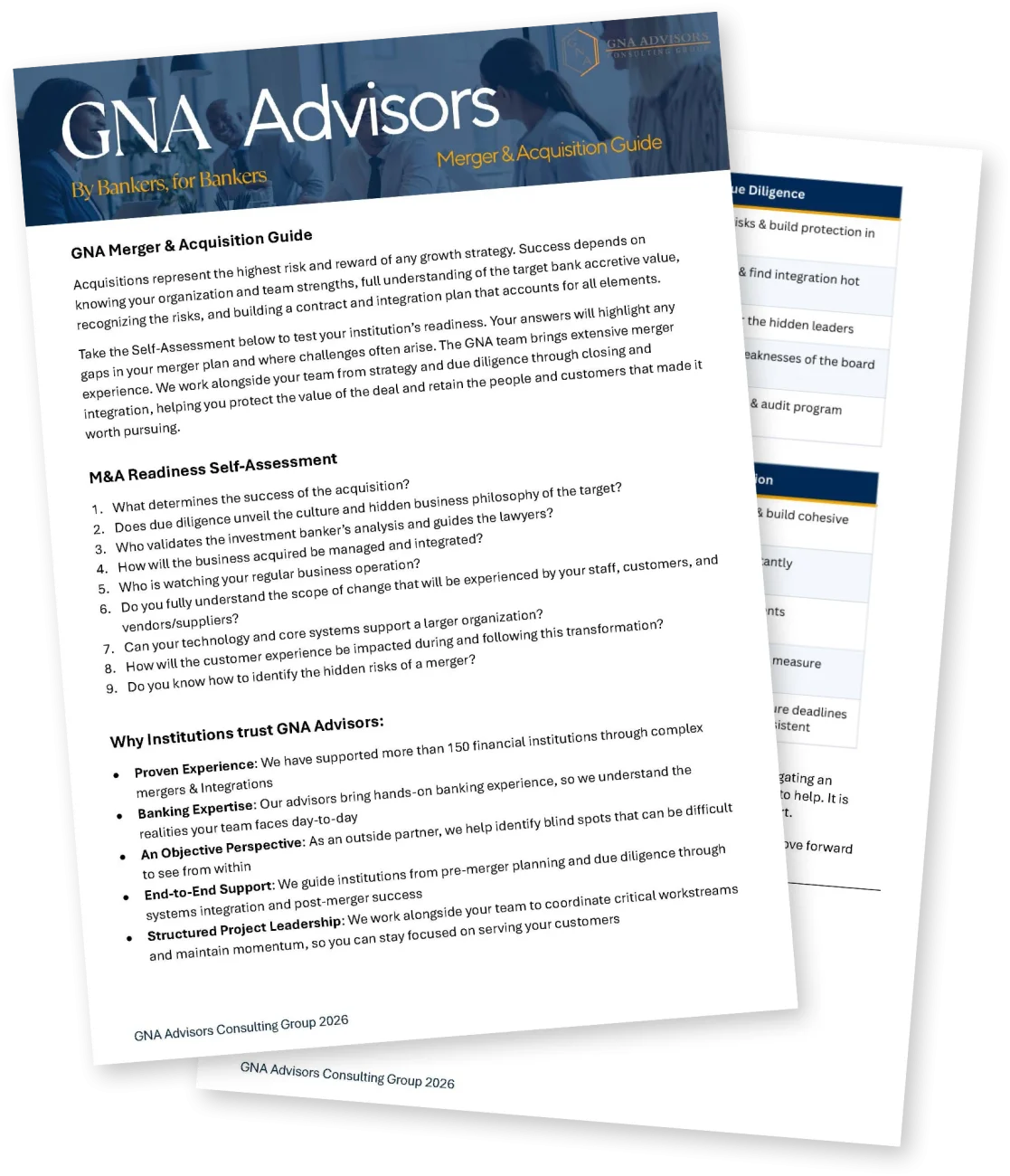
FREE M&A GUIDE
Download our free PDF self-assessment and guide to determine if you’re ready for a conversation.
Let’s Work Together
GNA Partnership At A Glance:
From early planning through post-merger integration, GNA helps you see what’s ahead, prepare your people, and execute with confidence.
- Change Management
- Culture Alignment
- Due Diligence
- Gap Analysis
- Identify Hidden Costs
- Pre-Merger Planning
- Project Management
- Systems Integration
- Vendor Management
Common Questions About M&A Readiness
Before entering into a merger or acquisition, a financial institution should evaluate strategic fit, financial performance, capital requirements, regulatory considerations, technology and core systems, vendor contracts, operational processes, staffing, culture, and overall cost. A thorough evaluation in each of these areas helps leadership determine whether the transaction is likely to deliver its intended value.
From a strategic and financial perspective, leadership should assess how well the two institutions align in goals, markets, and financial performance, and whether the combined organization will meet capital requirements. On the operational side, the evaluation should include each institution’s technology and core systems, vendor contracts and their termination terms, and day-to-day processes, since these often drive the cost and complexity of conversion. Finally, leadership should consider staffing and culture, as differences in how the two institutions operate and treat their employees and customers can significantly affect integration success.
The biggest challenges banks face during a merger or acquisition include integrating technology and core systems, converting data, consolidating vendors, aligning policies and procedures, managing employees and organizational structure, integrating loan and deposit operations, communicating with customers or members, and meeting regulatory requirements. Most of these challenges are connected, so a delay or issue in one area can affect the timeline and outcome in others.
Technology and data challenges often receive the most attention because the core system conversion touches nearly every account and department. However, the people and process challenges can be just as significant. Aligning two sets of policies and procedures, defining a new organizational structure, and supporting employees through change all require careful planning. Throughout the transaction, the bank must also keep customers or members informed and satisfy regulatory requirements, which makes clear communication and early coordination essential.
A bank should begin integration planning as early as possible, ideally during due diligence and well before the transaction closes. Early planning gives leadership time to identify system dependencies, contractual obligations, operational gaps, staffing needs, and conversion requirements, all of which can significantly affect the timeline and cost of a transaction.
When the deal timeline allows, starting 12 months or more before the planned systems conversion date gives the bank the most room to manage vendor notifications, data mapping, testing, and staff training. Many transactions move on shorter timelines, which makes early, structured planning even more important for keeping the conversion on schedule and within budget.
A comprehensive bank merger and acquisition plan should cover every area of the institution that the transaction will affect, including technology, operations, vendor management, people, compliance, and customers. Building the plan with subject matter experts from both banks helps ensure that no critical dependency is overlooked.
On the technology side, the plan should address the core system conversion and data conversion. Operationally, it should cover lending, deposits, finance, facilities, and day-to-day operations. The people side of the plan should include human resources, staff training, and internal and external communications. The plan should also account for updates to policies and procedures, regulatory compliance, and the overall impact on customers. Vendor management should be addressed across every one of these areas, since most departments rely on third-party contracts and services that will need to be reviewed, consolidated, or terminated.
The bank’s internal plan should also incorporate the data conversion plans provided by third-party vendors, such as the core processor, so that timelines, responsibilities, and testing schedules stay aligned across all parties.
A bank should bring in an outside consultant as early as due diligence, and no later than the start of integration planning. Engaging a consultant early gives the consulting team time to build rapport and trust with leadership and staff, learn how the institution operates, and identify risks before they affect the timeline.
An experienced consultant can help the bank assess operational and technology readiness during due diligence, build and manage the integration plan, coordinate with vendors and the core processor, and keep each department accountable to conversion milestones. Bringing in outside support after integration is already underway is still valuable, but it often means less time to learn the institution and address issues before conversion.
A consultant’s role during a bank merger or acquisition depends on the institution’s needs, and can range from high-level strategic guidance to hands-on support within individual departments. At GNA Advisors, our team’s banking experience allows us to serve in whichever roles a bank requires throughout the transaction.
These roles include executive advisory support for senior leadership, department-level advisory for areas such as lending, deposits, operations, and finance, and overall project management of the integration plan. GNA Advisors also provides vendor management consolidation, conversion and testing management, and balancing support to confirm that account and financial data reconcile accurately after conversion.
The biggest operational risk in a bank merger or acquisition is data management and integrity during the conversion. If data is not thoroughly tested and is converted incorrectly, the bank can face significant operational, regulatory, and reputational consequences.
Conversion errors can affect account balances, interest rates, loan terms, customer statements, and regulatory reporting, and problems are often discovered only after customers notice them. Reducing this risk requires careful data mapping, multiple rounds of testing, including mock conversions, and thorough balancing after conversion to confirm that every account and financial record reconciles accurately.
During post-merger integration, bank leadership should prioritize three areas: customers, employees, and operational stability. Each requires focused attention in the first weeks and months after conversion, when the institution is most vulnerable to service disruptions.
Customer inquiries typically increase significantly for the first 14 to 30 days after conversion. Leadership should add staff or engage third-party support so that calls, questions, and service requests are handled promptly during this period.
Employees will be adjusting to new systems, policies, and procedures at the same time. Leadership should provide additional support to the teams most affected and watch closely for areas where further training is needed.
Operational stability should remain a priority for the first 30 to 90 days after conversion. This work includes adjusting procedures, completing reconciliations, and cleaning up converted data. To give employees the time this requires, leadership should place non-essential projects on hold until operations have stabilized.
One of the most common reasons bank mergers and acquisitions fail to achieve their expected results is a rushed timeline. When the schedule does not allow for proper planning and discovery, execution risk rises significantly, and the resulting uncertainty can lead to negative impacts on customers and operations.
A compressed timeline often means that system dependencies, vendor obligations, and data issues are identified too late to address properly, and that testing is cut short before conversion. The consequences can include conversion errors, service disruptions, employee burnout, and customer attrition, all of which can erode the cost savings, growth, and customer retention the transaction was expected to deliver. Allowing adequate time for planning, discovery, and testing is one of the most effective ways to protect the value of a transaction.
Why Banks Partner with GNA
M&A is not a side project. It requires focused attention across operations, technology, culture, vendors, and customer experience, while your team is still responsible for running the bank.
GNA provides experienced resources and structured project leadership to help institutions manage that complexity. We work alongside your team to identify risks early, coordinate critical workstreams, and maintain momentum from due diligence through post-integration.
GNA helps financial institutions manage operational, technological, cultural, and organization integration before and after closing.