
OUR SERVICES
Systems Conversions
Your Core Conversion is Not an IT Project. It’s an Institution-Wide Transformation.
A system conversion affects virtually every part of your institution: operations, employees, customers, vendors, data, and technology. Successfully navigating that change requires far more than implementing new software.
GNA advisors bring extensive experience across complex implementations to help financial institutions plan realistically, coordinate resources, manage vendors, prepare employees and customers, and address issues before they become post-conversion problems.
Conversion Readiness
Preparing for a Successful System Conversion
Planning a system conversion? Your answers to a few key questions can help identify whether your institution is prepared for the operational impact of the transition, and where additional planning may be needed.
Ask Yourself:
- Do you have adequate resources available to commit to an organization-wide transformation?
- Do you have the internal resources to manage the conversion while maintaining day-to-day operations?
- Have you determined who will serve as the bank’s advocate throughout the conversion project?
- Have you accounted for data migration, testing and third-party vendor integrations?
- Are your employees prepared for the training and process changes ahead?
- Do you have a plan to minimize disruption for your customers?
From initial planning through post-conversion, GNA Advisors provides hands-on support at every stage of your system conversion.
Whether you are preparing for a conversion or already underway, GNA Advisors can help you identify potential gaps, understand where your institution stands, and determine what needs attention to keep your project on track.
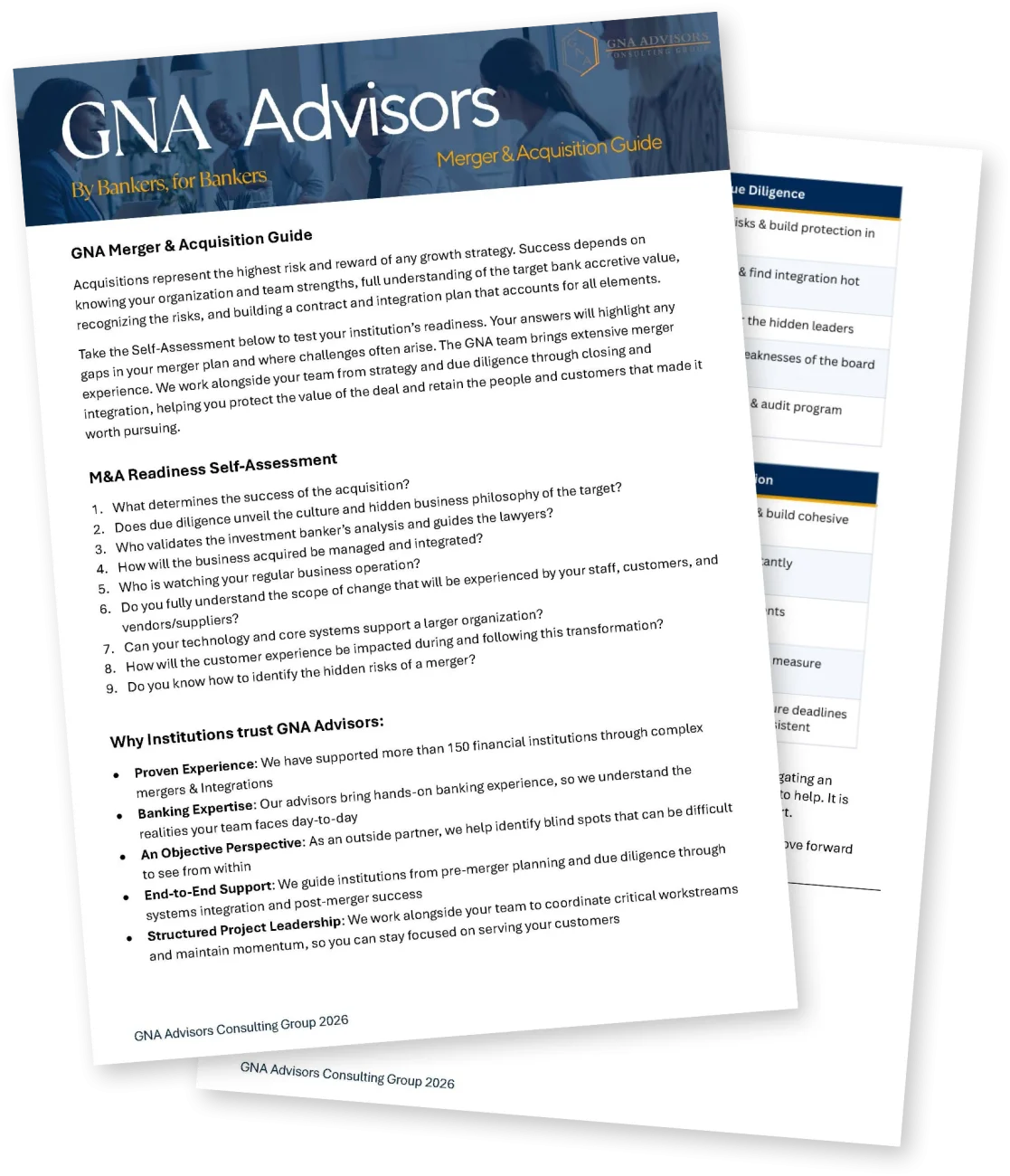
FREE CONVERSION GUIDE
Download our free PDF self-assessment and guide to determine if you’re ready for a conversation.
Let’s Work Together
GNA Partnership At A Glance:
GNA helps you manage the complexity beyond the technology, so your conversion works for your people, your customers, and your long-term strategy.
- Call Center Support
- Core Conversions
- Customer Impact
- Data Migration
- Process Integration
- Resource Commitment
- Testing
- Training
- Vendor Consolidation
- Vendor Management
Common Questions About System Conversions
A core conversion is the process of moving a bank or credit union from its existing core banking system to a new core processing platform. The core system is the central software that stores and processes all customer, account, and transaction data, so converting it is one of the most significant technology projects a financial institution can undertake.
A core conversion project typically includes:
- Technology changes: Replacing or upgrading the core processing software and supporting infrastructure.
- Data conversion: Migrating customer, account, and transaction data accurately from the old system to the new one.
- System and vendor integrations: Connecting the new core to ancillary systems such as digital banking, card processing, lending, and reporting platforms.
- Testing: Validating data, integrations, and processes before and after the conversion.
- Training: Preparing staff to operate effectively on the new system.
- Operational process updates: Revising procedures and workflows to align with the new platform.
A core conversion replaces a financial institution’s core processing system with entirely new software, while a merger conversion moves one institution’s data onto a core system that at least one of the merging institutions already uses. Because a core conversion introduces a new system for everyone, it is a significantly more complex undertaking. Based on GNA Advisors’ experience, a merger conversion typically requires roughly 15 to 20 percent of the effort involved in a full core conversion.
Key differences between a core conversion and a merger conversion:
- Testing and validation: In both projects, teams must validate the accuracy of converted customer, account, and transaction data. In a core conversion, teams must also execute transactions and perform operational functions on the new system to confirm it works as intended.
- System familiarity: In a merger conversion, at least one institution keeps its existing core system and staff already know how to use it. In a core conversion, every user must learn a new platform.
- Training: A core conversion requires extensive training across the entire organization, while merger conversion training is generally limited to the acquired institution’s staff.
- Operational processes: A core conversion requires updating virtually all operational processes and developing entirely new procedures. A merger conversion largely relies on processes that are already in place.
The timeline may vary greatly based on the institution’s size, the core platform, the FI’s product offerings, system integrations, and the number of resources dedicated to the project.
Factors that affect the length of a core conversion:
- Dedicated resources: Institutions that commit sufficient internal staff and experienced outside support are better positioned to stay on schedule.
- Institution size: Larger institutions with more accounts, branches, and staff generally require longer timelines.
- Core platform: Each core provider has its own implementation methodology, conversion schedule, and resource availability.
- Product offerings: Institutions with a broader or more specialized range of products require more time to map, configure, and test.
- System integrations: The number and complexity of third-party systems connected to the core, such as digital banking, card processing, and lending platforms, can significantly extend the timeline.
A bank or credit union should begin planning for a core conversion as soon as it decides to explore new core processing options, ideally before engaging with core vendors. Early planning gives the institution a clear picture of its current environment, which leads to better vendor evaluations, stronger contract negotiations, and a smoother conversion.
Early planning steps for a core conversion:
- Define the project team: Designate internal leaders and subject matter experts, and determine whether outside support will be needed.
- Review current contracts: Identify the expiration date, renewal terms, notice requirements, and any deconversion fees in your existing core and ancillary vendor agreements.
- Document existing processes: Record how current operational processes work so they can be evaluated and redesigned for the new system.
- Inventory product offerings: Gather and document all current deposit, loan, and service products, including their features and configurations.
Identify system integrations: List every third-party system connected to the current core, such as digital banking, card processing, and lending platforms.
No, a financial institution should not rely on its core vendor alone to lead a core conversion. While most core providers assign a conversion or implementation team to work alongside the institution, the vendor’s role is focused on its own system. The institution remains responsible for leading the broader transformation, including managing change across employees, customers, and third-party vendors.
Why institutions need their own dedicated project resources:
- Full-time leadership is required: Navigating the change curve successfully requires several project leaders and team members from within the institution to commit to the project full-time.
- The effort is often underestimated: A successful core conversion requires a significant and sustained time commitment that many institutions do not anticipate.
- The vendor’s scope is limited: Core provider teams typically focus on configuring their platform and converting data, not on redesigning the institution’s operational processes or managing internal change.
- The scale of change is significant: Employees must learn a new system, customers may experience changes to products and services, and third-party vendors must be coordinated and integrated.
No, a core conversion should not be led by the IT department alone. Although a core conversion requires a tremendous amount of technology work, it also has a significant impact on business line staff and customers. The most successful conversions are led jointly by technology and business leaders, with clear plans for training employees and communicating changes to customers.
Why a core conversion is more than a technology project:
- Communication and training must be prioritized: Developing an action plan for training staff and communicating anticipated changes to customers is essential to a successful conversion.
- Nearly every integrated system is affected: A core conversion can impact digital banking, loan origination software, payments, debit cards, ATMs, and many other systems connected to the core platform.
- Business line users must adapt: Staff across lending, deposits, operations, and customer service will need to learn new systems and adopt new procedures.
- Customers will experience changes: Although institutions work to minimize disruption, some changes to the customer experience are inevitable.
A financial institution should dedicate full-time resources to a core conversion for the entire duration of the project. Many institutions underestimate this need and try to staff a core conversion the same way they would a merger conversion, with existing employees managing conversion work alongside their regular duties. That approach often fails because of the scope and magnitude of a core conversion.
Why the merger staffing model doesn’t work for a core conversion:
- Dedicated resources drive success: Core conversions are most successful when full-time project leaders and team members are allocated from start to finish.
- Merger conversions are smaller in scope: In a merger conversion, conversion tasks typically represent a fraction of an employee’s normal workload, so part-time participation can be effective.
- Core conversions affect the entire institution: Every department must learn a new system, redesign processes, and validate data and transactions, which far exceeds what employees can manage alongside their daily responsibilities.
- Divided attention creates risk: When staff are stretched between conversion work and regular duties, deadlines slip, testing becomes less thorough, and both the project and day-to-day operations can suffer.
The best way to manage decisions during a core conversion is to establish a structured decision governance process at the start of the project. Every decision made during a conversion affects other areas of the institution, including training needs, the customer experience, and internal procedures. A formal governance process ensures decisions are made with the right input, documented clearly, and communicated across the organization.
Key elements of effective decision governance for a core conversion:
- Organization-wide communication: Share decisions promptly with all impacted teams to prevent confusion and ensure coordinated implementation.
- Defined decision authority: Establish who has the authority to make and approve decisions, typically through a steering committee or executive sponsor, along with a clear path for escalating issues.
- Cross-functional input: Decisions cannot be made in a vacuum. Involve the departments affected so downstream impacts on training, customers, and procedures are understood before a choice is finalized.
- Clear documentation: Maintain a decision log that records each decision, the reasoning behind it, who approved it, and the areas it affects.
The five key success factors for a core conversion are realistic timelines, dedicated full-time institution resources, a thorough testing plan, a documented communication strategy, and a comprehensive training plan for both staff and customers. Based on GNA Advisors’ experience, the most successful core conversions consistently include all five.
- A comprehensive training plan: Prepare staff to operate confidently on the new system and help customers understand and adapt to any changes in the products and services they use.
- Realistic timelines: Build a project schedule that accounts for the full scope of the conversion, including data mapping, integrations, testing, and training, rather than an optimistic target that leaves no room for issues.
- Dedicated full-time resources: Commit project leaders and team members from within the institution who can focus on the conversion full time for the duration of the project.
- A thorough testing plan: Develop a solid testing plan that validates converted data, system integrations, transactions, and operational functions before conversion weekend.
- A documented communication strategy: Identify the areas where customers will be affected and establish a clear plan for communicating changes to customers, employees, and third-party vendors.
Banks can minimize customer disruption during a core conversion by managing the change curve effectively and maintaining strong, transparent communication across the entire project team. When project leaders openly identify challenges, risks, and issues early, obstacles can be fully vetted, prioritized, and planned for before they affect customers or staff.
Ways to minimize customer disruption during a core conversion:
- Plan for post-conversion support: Increase staffing and extend service hours in the days following conversion to respond quickly to customer questions and concerns.
- Create a forum for transparency: Give project leaders a regular venue to raise challenges, risks, and issues openly so they can be addressed before conversion weekend.
- Communicate on a regular cadence: Encourage project team members to share updates consistently to avoid surprises for staff or customers.
- Maintain cross-functional visibility: Ensure every team understands how its work affects other areas of the institution and the customer experience.
- Notify customers in advance: Inform customers early about any changes to account numbers, online banking credentials, debit cards, statements, or other services they use.
- Prepare frontline staff: Equip branch and contact center employees with talking points and answers to common questions so they can support customers confidently.
Why Banks Partner with GNA
System conversions place extraordinary demands on internal teams. Employees must learn new technology while redesigning processes, testing integrations, preparing customers, and continuing to perform their day-to-day responsibilities.
GNA provides the experienced project leadership and additional capacity institutions need to manage the transition. From planning and data migration to testing, training, vendor coordination, and customer readiness, we help keep the entire conversion moving toward a successful go-live.